Printed vs Rhinestone Heat-Transfer Designs
Compare printed, rhinestone, and mixed heat-transfer designs by artwork detail, garment feel, visual distance, and sample evidence.
Buyer perspective
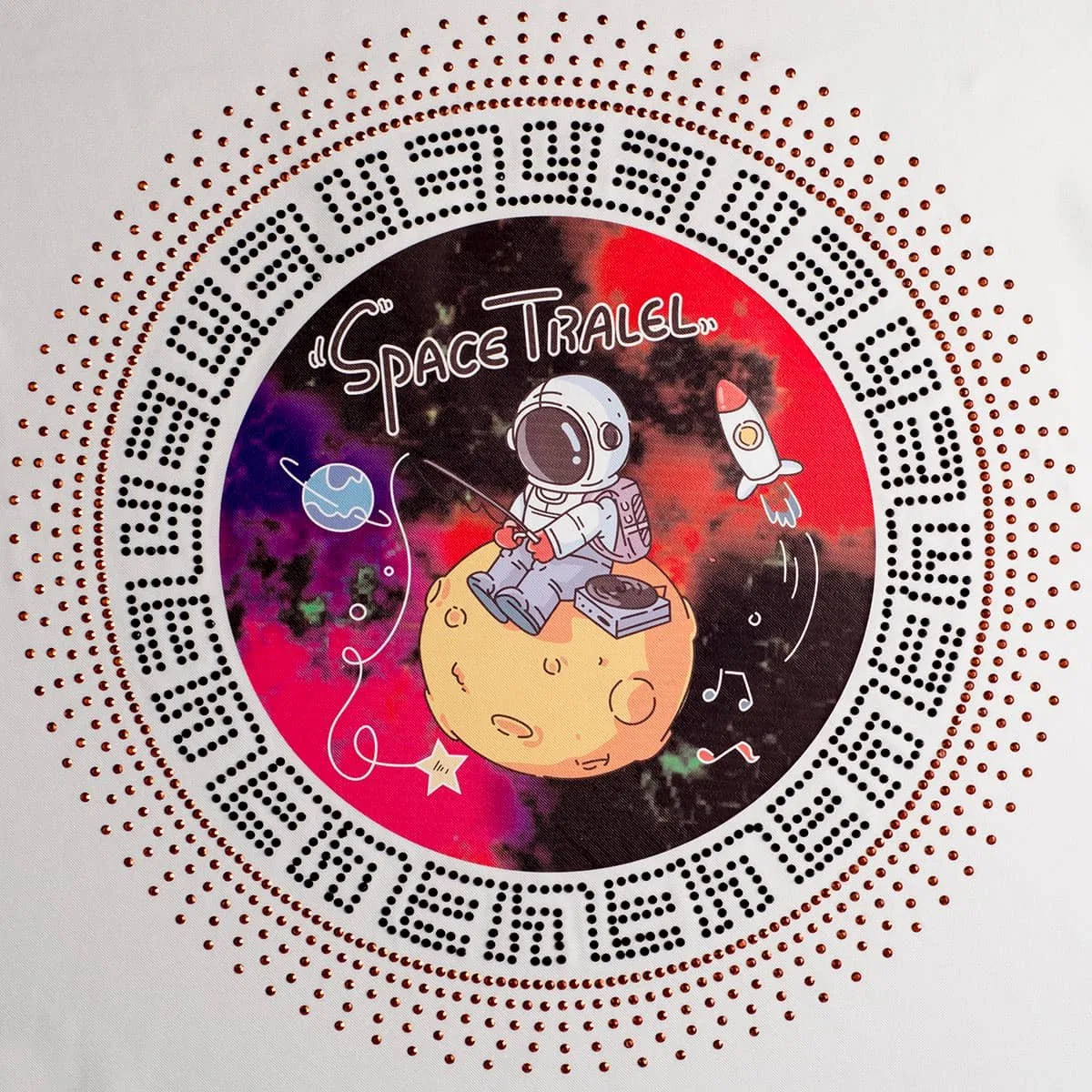
Print and stones solve different visual problems. Print can carry fine color detail; rhinestones create points of reflected light and raised texture. A mixed design may use both, but alignment and application become part of its specification. The photographed item illustrates one combined direction, not a universal process.
Options
Choose what print and stones each need to carry
The decision is not whether print or rhinestones are universally better. It is which visual information must be reproduced on the selected garment. Route the same authorized artwork through three mockups before requesting comparable applied samples.
Printed route
Assign gradients, fine lines, and small color fields to a print-only version. Inspect whether the detail remains readable and whether the printed area feels appropriate on the chosen blank.
Stone route
Simplify the motif to a stone-readable silhouette and examine the physical spacing at final dimensions. Check normal-distance legibility without magnifying the proof.
Combined route
Give print and stones noncompeting jobs, then record alignment and process sequence for a tested sample. Compare all three on the same garment and in the same light.
Select the simplest construction that achieves the intended visual effect on the real product; extra layers require a visible benefit.
What to decide
Build a brief that can be tested
- 1
Route checkpoint
Assign each element a job
Identify text, gradient, outline, and highlight areas in the artwork. Choose which must print and which merit stones. At actual garment size, check whether the two effects remain separate or compete for attention.
- 2
Route checkpoint
Compare on one blank
Sample printed, rhinestone, and combined options on the same garment model and color. View at normal distance and under consistent light. Note hand feel, stretch response, and whether printed edges or raised stones interfere with seams.
- 3
Route checkpoint
Approve the process sequence
Ask for the exact construction and application instructions for each option. For a mixed design, record registration, order of operations, and finished inspection criteria. Care results belong to the tested garment and sample only.
Bring to the inquiry
- Layered artwork and effect roles
- Exact garment and placement
- Comparable physical samples
- Application and inspection record
Request a Bulk Quote
Send your artwork, quantity, destination, and specifications for a tailored quote.