Open spacing
2.2 cm / 100 g
Archived width and weight for an approximately 90 cm reference length. Lay the sample across a full seam to judge visible gaps between clusters.
Density decision / TB-RTC-CSD-028
Sparse and dense crystal chain trims
Compare open spacing with the dense treatment before choosing a color. A decorated edge can change weight, motif frequency and drape even when the width looks close in a photograph.
Open spacing
2.2 cm / 100 g
Archived width and weight for an approximately 90 cm reference length. Lay the sample across a full seam to judge visible gaps between clusters.
Dense treatment
2.1 cm / 120 g
The closer motif rhythm is recorded as heavier over the reference length. Verify how that load behaves on the intended edge.
Pin a continuous sample along the actual neckline, strap or bag edge. Record how many decorative clusters land around corners and closures; the visual difference between sparse and dense is easiest to miss when only one motif is viewed at a time.
Ask for a measured repeat and a photograph of the proposed cut location so that the first and last flower are not damaged by finishing.
A delicate fabric may react differently to the two recorded weights; a rigid accessory may expose stiffness at a bend instead. Mount both samples to the intended material and compare hang, face-down contact, snagging and recovery after ordinary handling.
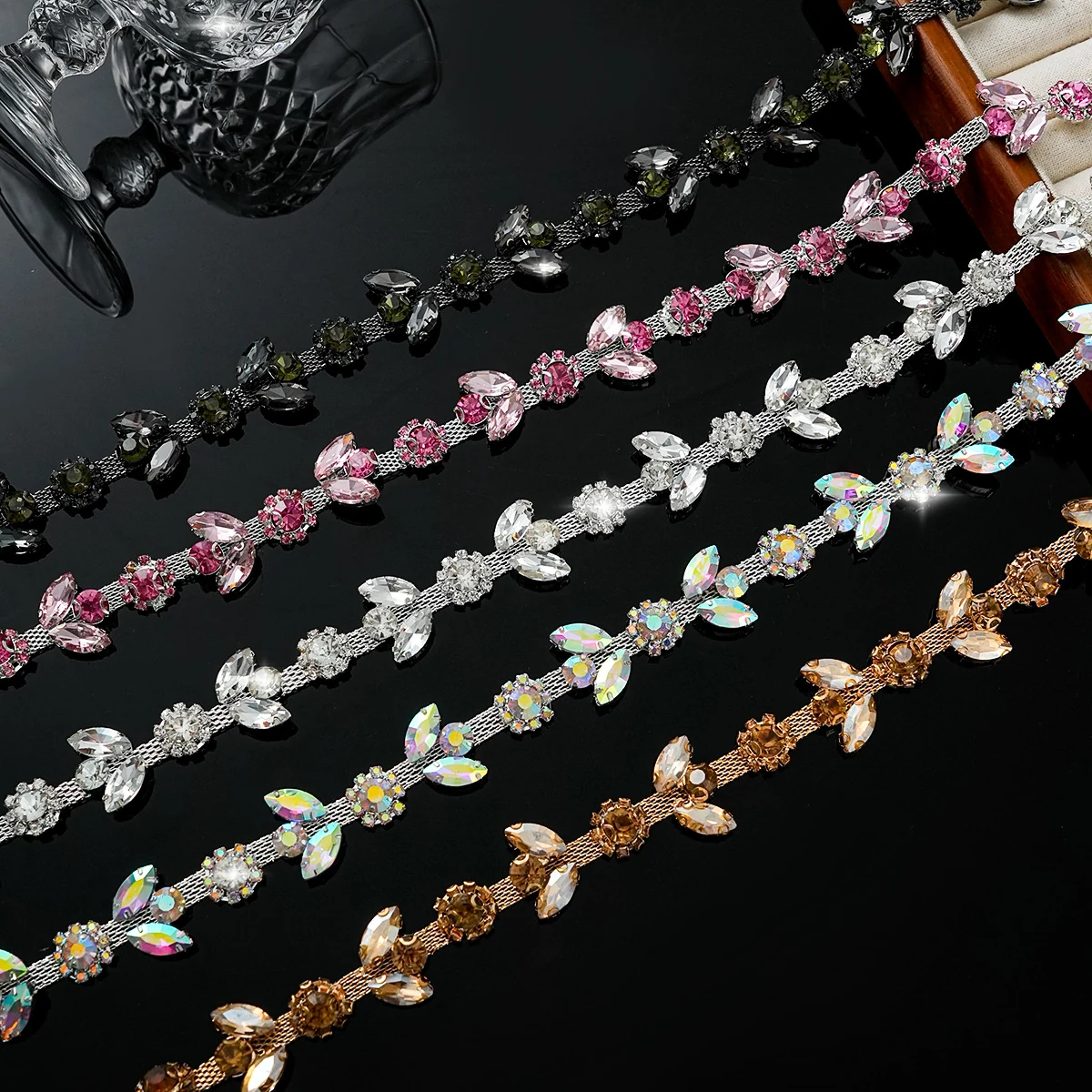
The pictured dark, pink, clear, iridescent and warm-tone lines are visual references, not a guarantee that every finish is offered in both densities. Attach a marked photograph or physical swatch to each line of the order, and state its required continuous length and position on the finished article.
The archived reference uses approximately 90 cm lengths, while the site’s current MOQ label is 50. Request a written definition of one sale unit, present width and weight tolerances, and whether two spacing treatments or several colors can be combined within that minimum. Price and lead time should follow the approved variant list.
Receiving standard
Mark the first and last complete flower clusters on the approved sample, then measure a continuous interval rather than judging one close-up. Compare the same interval on the delivered sparse or dense version for cluster count, missing stones, connector damage and straightness. Keep the selected color and spacing photograph with the order so the two treatments cannot be mixed during receiving.
The four-petal clover crystal trim uses another repeated outline and should be sampled separately from these flower-cluster spacing options. Review the broader Rhinestone Trims & Chains category when comparing edge silhouettes.
The archived record lists about 2.2 cm for sparse and 2.1 cm for dense. Those are variant references, not a tolerance guarantee; measure the selected physical sample.
The reference gives 100 g for sparse and 120 g for dense per approximately 90 cm length. Confirm the current measured unit and how the chosen trim affects the receiving fabric.
Do not assume variant mixing. The site currently labels an MOQ of 50; ask the quote to identify the sale unit and minimum for each density and color.