Mixed stone geometry
Square centers and round perimeter stones create a visibly different rhythm from conventional all-round lettering.
Square crystals form the interior grid while small round stones articulate the edge and letter details.
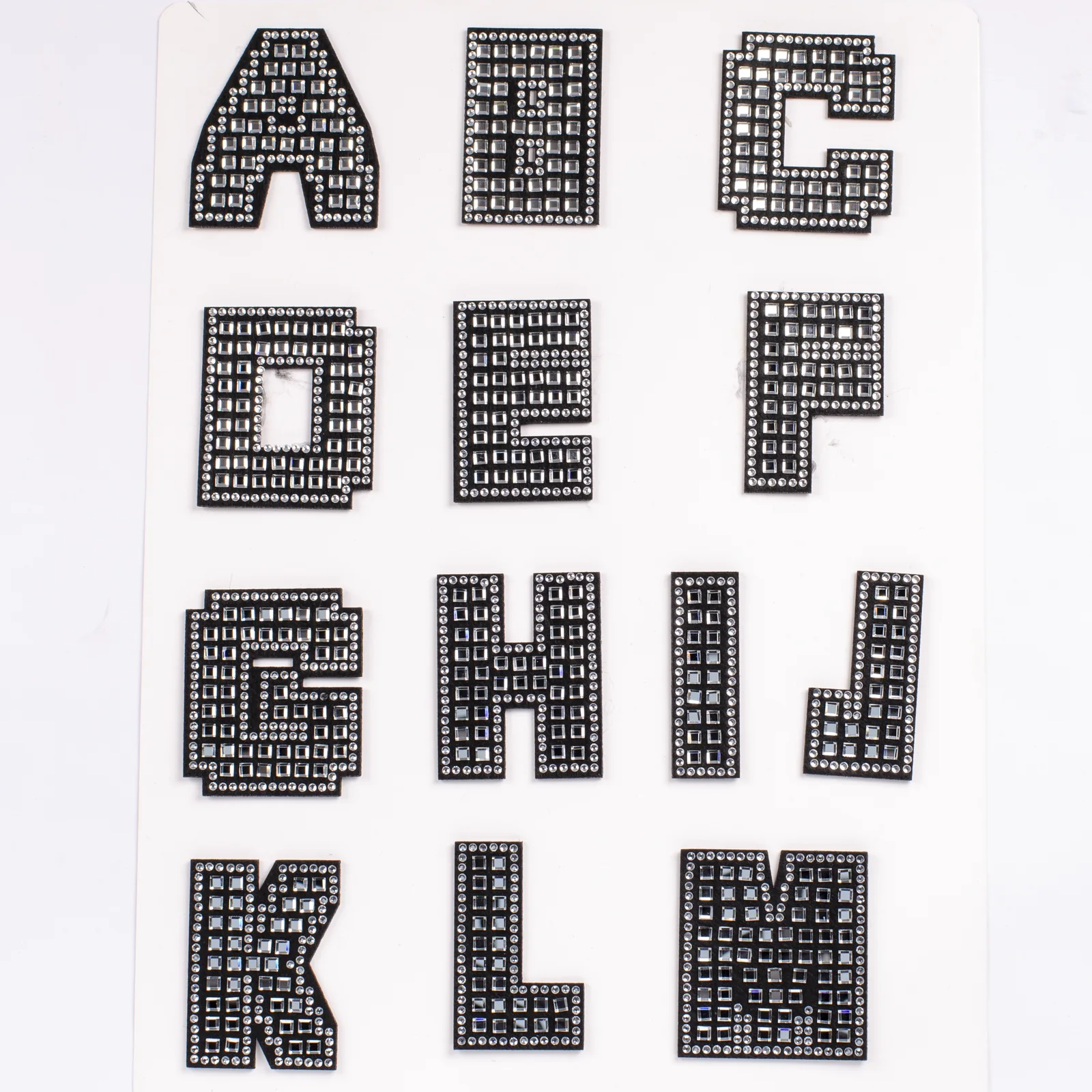
This alphabet treats each character as a geometric crystal panel. Rows of square stones occupy the broad strokes, while round crystals describe borders, counters, and narrower turns on the black base shown in the reference.
Reference measurements come from the catalog record. The current MOQ is 50 pieces; confirm specifications, price, and lead time in writing before production.
Finished height matters here because the square grid and small interior openings must remain legible in the chosen characters.
Square centers and round perimeter stones create a visibly different rhythm from conventional all-round lettering.
Regular square spacing emphasizes the straight sides and broad faces of the uppercase forms.
Smaller round crystals keep openings such as A, B, D, and R legible within the dense layout.
The wide block shapes suit single initials and short combinations that can carry a substantial crystal field.
List every initial or phrase, the count per letter, and the available placement area so the mixed-stone grid can be reviewed at scale.
Share the final sequence of letters and the number of completed sets.
Review how square rows and round borders translate at the requested scale.
Approve a character with counters or diagonal strokes before the full alphabet mix proceeds.
Confirm grouping and labels for the approved custom letter assortment.
Use one or two large characters as a focal mark on jackets, backpacks, or performance pieces.
Assemble short names whose straight block strokes benefit from the repeated square-stone pattern.
Stock selected high-use initials with a specified replenishment mix for personalization counters.
The recorded construction combines a square-crystal lattice with a round-stone border on black textile. Specify that combination when asking LCHOTFIX for a matching wholesale reference.
Supply the complete word, required letter counts and target width. Mark any narrow spaces so the square grid and surrounding round stones can be reviewed at the intended scale.
A size change can alter the number of square stones that fit inside a letter. Ask LCHOTFIX to confirm the revised arrangement instead of assuming every size uses an identical grid.
Request a clear view where the round border meets the square interior stones. Use it to compare spacing, exposed textile and transitions around curves.
Include narrow and wide letters in the approval sample. Compare their visual weight and internal stone placement before approving the complete LCH-NP-ALP-02 letter mix.
Send the bag material, coating and intended placement. LCHOTFIX must confirm the backing and attachment method; the photographed stone pattern does not establish substrate compatibility.
List quantities by character and size, not only the total patch count. Ask whether your assortment has per-letter minimums and have those terms included in the written quote.
Review row alignment, rotation of individual stones and the consistency of gaps. Use the approved physical sample as the reference for the selected letter size.
Submit a finish reference and identify which stones would change: the square interior, round border or both. Availability and the resulting appearance require confirmation and sampling.
Specify sorting by letter, quantities per pack and any customer labels. Ask LCHOTFIX to confirm how the decorated faces will be separated for the agreed shipment.
Send your artwork, quantity, destination, and specifications for a tailored quote.